Commuter Town vs City Living: What the Numbers Actually Say About Your Real Cost
We compare what living in London versus a commuter town really costs: house prices, season tickets and the hours spent commuting.
RightRoute Team
· Data & Research
· 14 April 2026

"Just move to a commuter town" is advice handed out freely by people who haven't actually run the numbers. Sometimes it's right. Sometimes the house price saving is real but gets quietly eaten by season tickets, car costs, and the time you spend on trains every year. This post does the actual maths so you can work out which side of that line you're on.
The house price difference
Start with the headline. Average asking price for a home in Greater London in 2026 is roughly £517,000. In the most popular commuter towns, the equivalent property costs:
- St Albans: £545,000 (actually more expensive)
- Guildford: £440,000 (£77,000 less)
- Reading: £370,000 (£147,000 less)
- Chelmsford: £335,000 (£182,000 less)
- Tunbridge Wells: £425,000 (£92,000 less)
- Luton: £281,000 (£236,000 less)
- Swindon: £218,000 (£299,000 less)
Important caveat: these are comparisons for equivalent property types. The house you can afford in Swindon is a four-bedroom detached with a garden. The London equivalent for £265,000 doesn't exist outside Zone 6 anyway. The real question is: what does the same budget get you? In Swindon, £500,000 buys a large family home with parking. In London, it buys a small flat.
The season ticket cost
This is the number most people underestimate. Annual rail season tickets for a daily commute into London in 2026:
- St Albans to St Pancras: £2,939/year
- Reading to Paddington: £6,362/year
- Guildford to Waterloo: £3,933/year
- Chelmsford to Liverpool Street: £5,175/year
- Tunbridge Wells to Charing Cross: £5,962/year
- Swindon to Paddington: £8,791/year
Run those over 10 years and the longer-haul commutes start looking expensive. Swindon's £252,000 house price saving gets offset by £65,000 in season tickets over a decade. Still well ahead, but it's a meaningful erosion of the headline saving.
The time cost
This one doesn't show up in a spreadsheet but it's real. A 90-minute commute each way means 3 hours of travel a day, roughly 650 hours a year assuming 220 working days. That's 27 full days of your life spent on trains every year. Over a 10-year mortgage, 270 days. Nearly 9 months you can't get back.
This is why commute time deserves more weight than most people give it. A £100,000 house price saving that costs you 500 hours of life per year is a trade-off plenty of people end up regretting.
The break-even calculation
Here's a simple model for comparing London against a commuter town over 10 years:
- House price saving (commuter town is cheaper): +£X
- Cumulative season ticket cost (assuming daily commute): -£Y
- Additional car costs if needed: -£Z
For Reading vs London, assuming daily commuting:
- House price saving: +£147,000
- 10 years of season tickets: -£64,000
- Net financial saving: roughly £83,000, before interest savings from a lower mortgage.
For Swindon vs London:
- House price saving: +£299,000
- 10 years of season tickets: -£88,000
- Net financial saving: roughly £211,000, but at the cost of around 650 hours a year on trains.
The hybrid working variable
The 2026 working pattern changes this calculation significantly. If you commute three days a week instead of five, you can use a monthly flexi-ticket or pay-as-you-go rail, often 30 to 40% cheaper than an annual season ticket.
Running the Swindon example at three days a week:
- Rail cost: roughly £5,300/year instead of £8,791
- 10-year saving vs London: roughly £246,000
- Commute hours: around 390/year instead of 650
The hybrid worker gets most of the house price upside with a much lower time and money cost. If your employer is genuinely flexible on location, this changes the equation substantially in favour of commuter towns.
What city living still wins on
This isn't a one-sided argument. London has real advantages that don't show up in a cost comparison:
- Zero commute time if you work in the city. The 650 hours/year cost is zero.
- A bigger, more diverse job market. Easier to change employer without moving.
- Cultural infrastructure that no commuter town matches.
- Better airport access for frequent travellers.
- Proximity to a large professional and social network.
How to find your break-even town
The right answer depends on your commute frequency, household size, employer flexibility, and which towns are actually viable for your route. Generic advice only gets you so far.
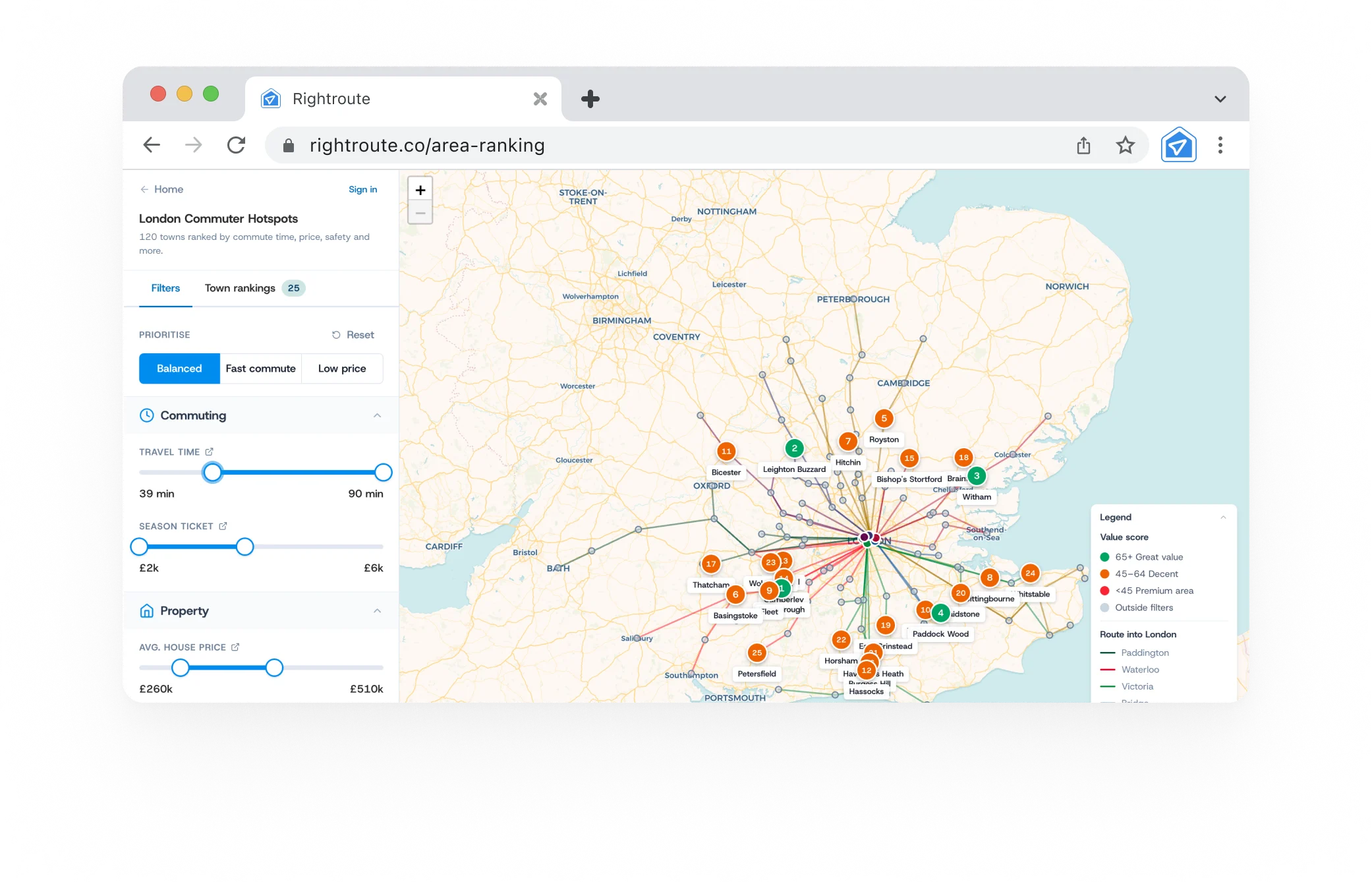
RightRoute's area comparison tool lets you model this yourself. Add London and any commuter towns you're considering, weight the factors that matter to you, and get a side-by-side comparison. It's the quickest way to stop debating in the abstract and start comparing your specific options.
Find your break-even commuter town: rightroute.co/app